
Elsewhere Art Fair Invited Outsiders Inside Philadelphia's Art Scene
Space On Space was a media partner at Elsewhere and pitched several journalists to promote the fair. I bought a few works for my personal collection. This is disclosed to remain in line with the current SOS Ethics Policy. Please weigh the essay as a personal dispatch rather than art criticism.
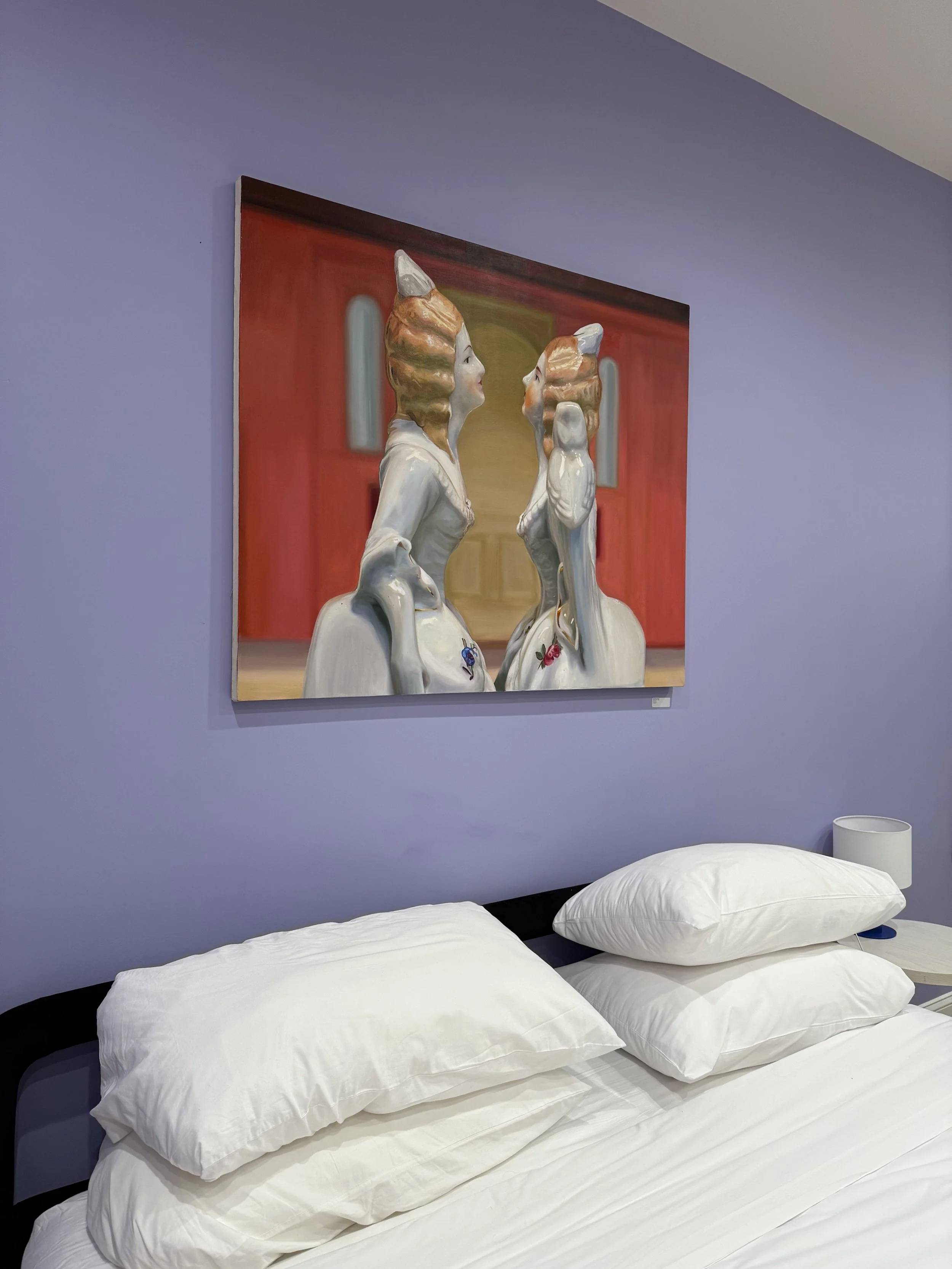
Emily Blair Quinn, Pecking Order, Oil on linen, 40 x 48 inches, 2026. Presented by 5-50 Gallery, Suite 203 at Elsewhere Art Fair 2026. Image courtesy of Space On Space Magazine.
Elsewhere was bustling with life on Wednesday’s VIP opening. Located inside YOWIE’s boutique hotel from June 3-6, 2026, this alternative fair, founded by Blah Blah gallerist Megan Galardi, provided an antidote to the larger, increasingly tired, contemporary art mega-fair model. In the same week that Pace Gallery conducted mass layoffs of both its staff and artist roster, Elsewhere was offering an alternative. As I arrived late, many art-chic people were already clustered both inside and outside the building. This wasn’t just a Philadelphia crowd: the outsider was being invited in. Emerging alongside Post-Fair, Season, Neighbors, Arrivals, etc., Elsewhere—positioned as part of the Semiquincentennial—carried a specific curatorial, historical, and cultural flavor that amplified the viewing experience.
I squeeze my way through the busy lobby of Forin Cafe, spotting artists I’ve been following online like Nazeer Sabree and Zeinab Diomande. There was friction between smooshing the body through crowds of people and seeing the work. Elsewhere is a more intimate, navigable format compared to the larger venue of Felix Art Fair located at the Hollywood Roosevelt Hotel in Los Angeles. Where Felix’s overcrowdedness felt overwhelming, Elsewhere’s hallway presentations in particular felt guiding and illuminating, even when full of people.
The hallway, as an architectural necessity, metamorphosed into a curatorial space, or a portal to an acquisition—sometimes it bottlenecked, other times it was a void.
The fair’s accessibility—being free and open to the public—and the chic design of the hotel created a warm, familial viewing experience where strangers could become friends, or strategic art connections could emerge.
“We were honored to be the venue partner for the inaugural Elsewhere Art Fair,” stated Shannon Maldonado, founder and art director of YOWIE. “Our hotel generates a lot of curiosity. We knew this partnership would be well worth it as we have attended many shows at Blah Blah Gallery and have been impressed and inspired by the roster of artists and exhibitions that Megan curates.” Maldonado mentioned that a few of her personal favorite booths were Indiana Hoover via Stowaway Gallery in Suite 202 and Point Blank and 5U Space in Suite 204A.
Dylan Riley, the director of Los Angeles-based artist-run Stowaway, shared, “Our primary takeaway was that Philly is an incredible city both for artists, art enthusiasts, and collectors. Indiana and I had so many great, earnest, and deep conversations about the work, the Philly scene, and others’ work that I don’t think could have happened at another fair.”
“Megan Galardi’s vision for Elsewhere is timely and urgently needed,” shared JLy (John Mauricio Lyons), senior foundation program specialist of the Independence Blue Cross Foundation. They continued, “As we celebrate Philadelphia in light of America’s Semiquincentennial, we also must acknowledge the more recent erosion of longtime artistic anchors regionally.”
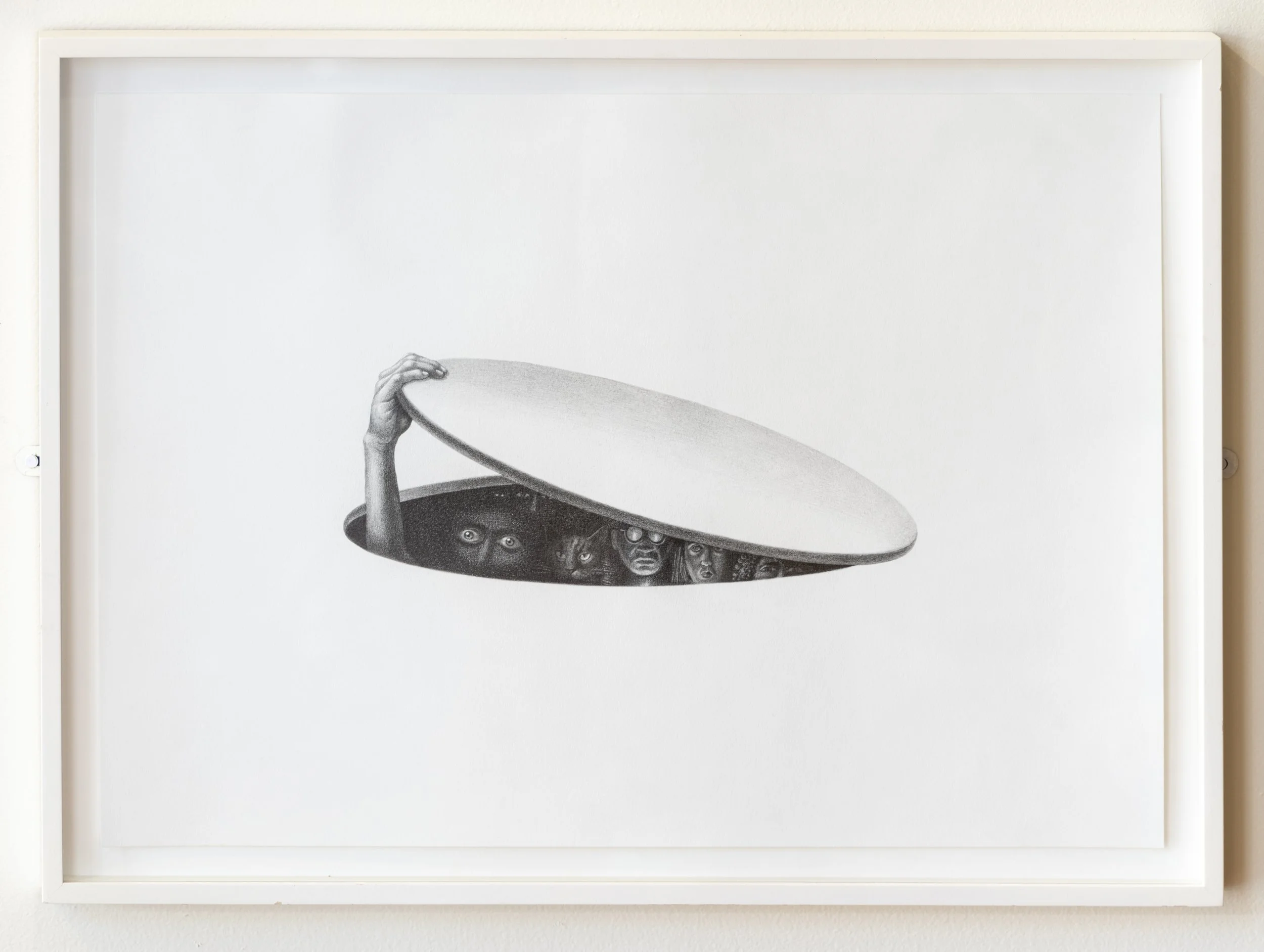
Armando Veve, End Times, Graphite on paper, 16 x 20 inches, 2018. Image courtesy of FJORD and the artist.
Armando Veve was the first of three Forbes 30 Under 30 (2018) artists I saw at Elsewhere. Presented by artist-run FJORD, Veve's pencil drawings welcomed guests in the lobby as they entered by elevator or stairwell. Veve’s precise, tightly rendered illustrations measure time moving slowly. I was struck by End Times, an illustration created for The New York Times BookReview. Artist Alexandria Nazar, who managed FJORD’s booth on Friday, said it was Veve’s version of the apocalypse. I saw a cat and a few curious figures peering out of a dark hole into a complete white space.
The first floor of Elsewhere was overwhelmingly Philadelphian. Suite 101 shared space with Blah Blah Gallery, Pretty Boy, and—a friendly neighbor—New York City’s Good Naked Gallery, owned by painter Jaqueline Cedar. Playing nicely in the room were two sculptural fire-inspired lamps by Philadelphia-based designer Carl Durklow, a custom headboard and handmade quilt by Libby Rosa, and abstract oil paintings of candlesticks guiding the night by Vincent Stacquadanio, among other standout works.

Emmanuel Massillon’s presentation at Elsewhere Art Fair 2026. Image courtesy of Harlesden High Street.
Walking up the steps, I spot the work of another Forbes 30 Under 30 (2026) artist, Emmanuel Massillon: a decommissioned prison phone between two bullet-studded masks, via London-based Harlesden High Street. Jonny Tanna of the gallery shared, “I was surprised by the type of clients Megan Galardi brought to the fair, and [Massillon] even gained an institutional placement as a result of exhibiting. It was a wonderful experience with the best host, and I loved the 70’s style opening party.”
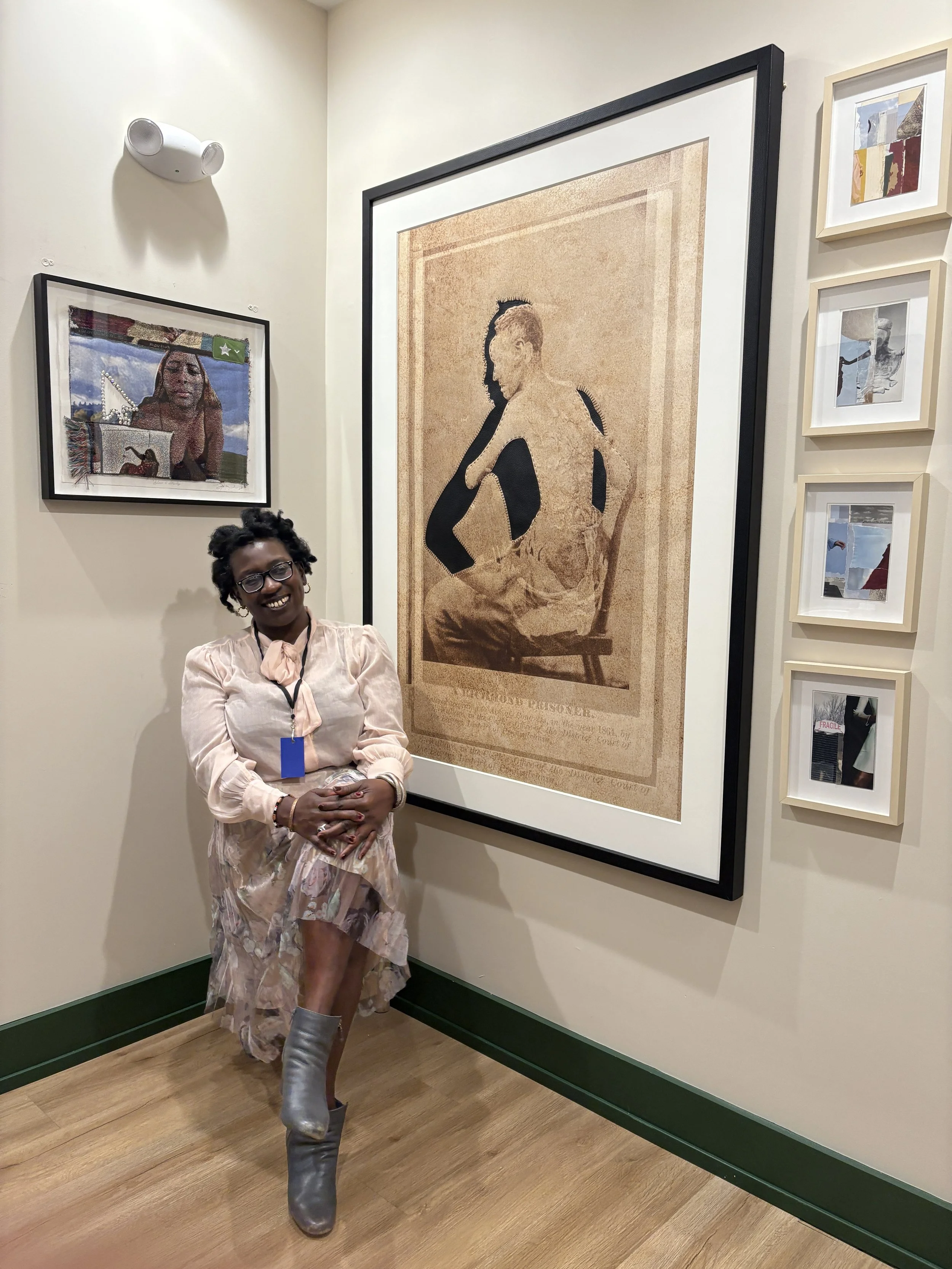
Dr. Darla Migan in front of her presentation, FOUND HER FOUND HER. Images courtesy of DARLA.
The act of meandering through hallways that would otherwise be liminal spaces became activated with a sharp, conceptual payoff. Particularly striking was the second-floor threshold where one encounters Dr. Darla Migan, the philosopher-critic-dealer in charge of DARLA, a nomadic gallery based in NYC. Here, we see a third Forbes 30 Under 30 (2025) Philadelphia-based artist, Qualeasha Wood. Wood’s confessional, jacquard tapestry with rhinestones, slow n steady was commissioned by The Studio Museum in Harlem. Six Black femme artists were included in Migan’s presentation, aptly titled FOUND HER FOUND HER.
While one might be tempted to resent occupying a hallway space for its added congestion, Migan stated this about her presentation, “to pass through FOUND HER FOUND HER, you can’t escape it. I became the passage through, making a metaphor about how reproductive labor, care work, and the structure of wealth creation in this country function.” Migan’s presentation also included tender collage works by N. Masani Landair and a haunting work called Archiving Ghosts by Mary Enoch Elizabeth Baxter.
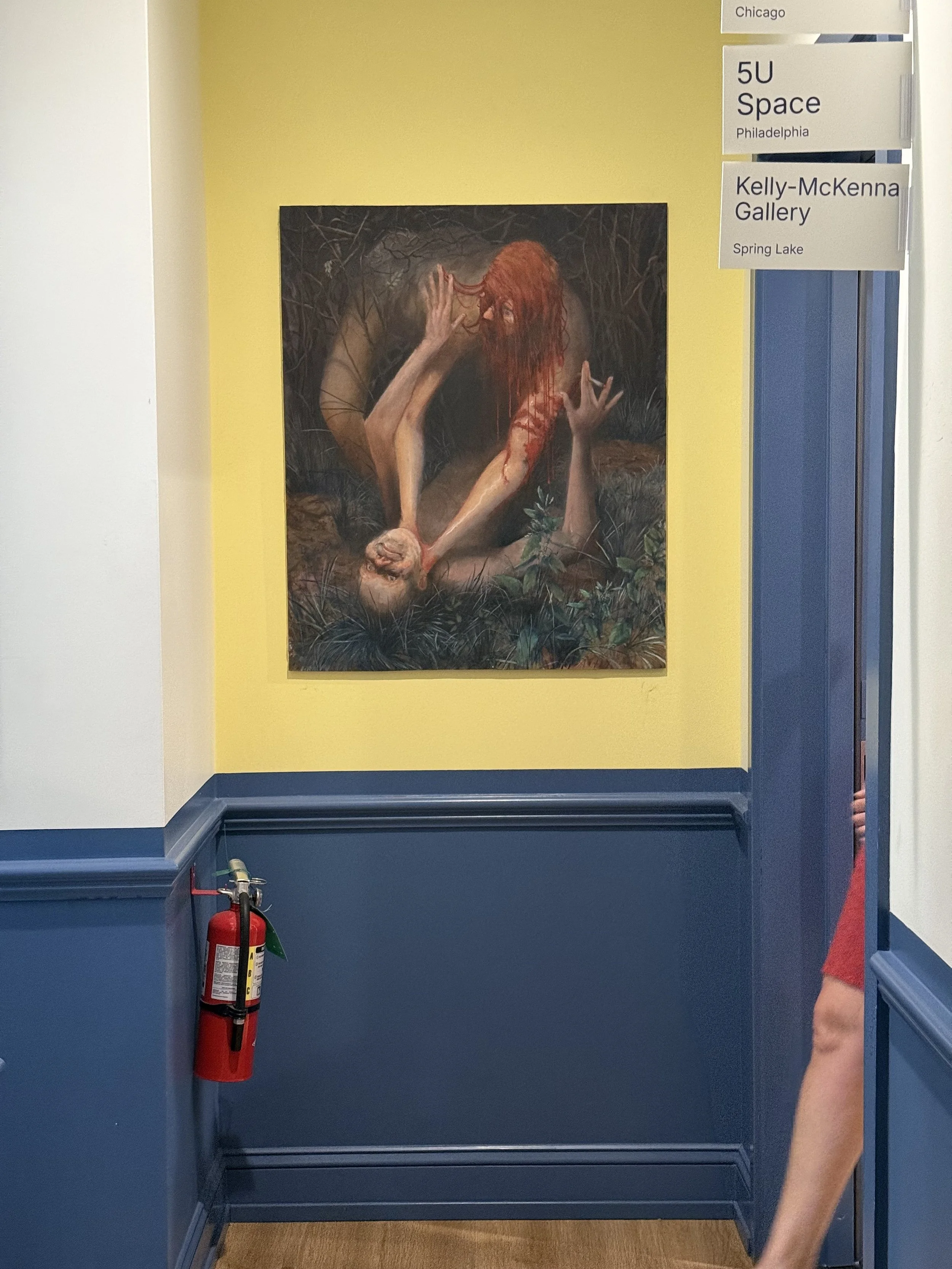
But First a Cigarette in the second-floor hallway of Elsewhere Art Fair 2026. Image courtesy of Space On Space Magazine.
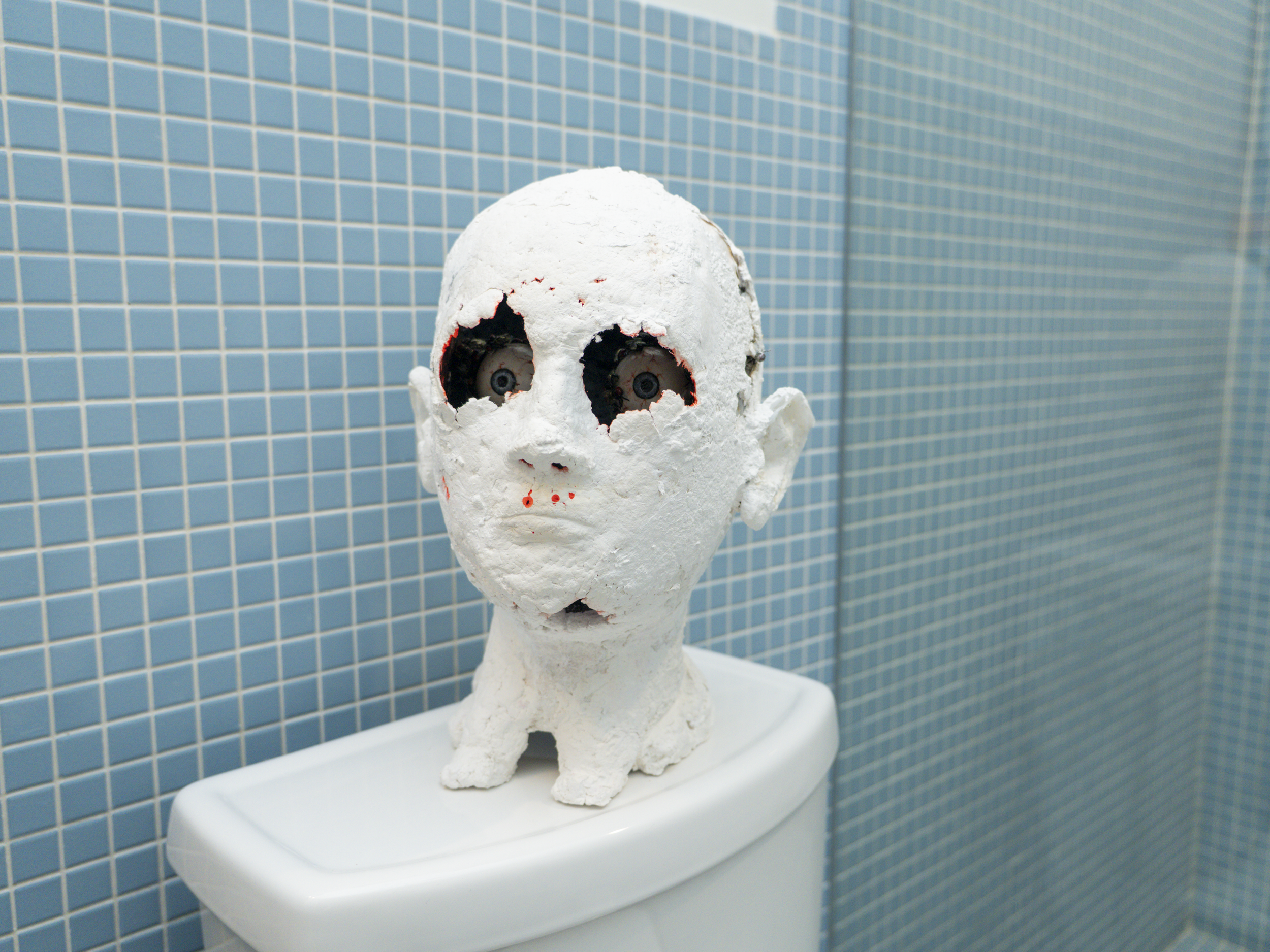
My Friend is Never Worried. Image courtesy of 5U Space.
The body turns the corner only to witness violence at the end of the hall in the form of a painting titled But First a Cigarette by Nicholas Stathopoulos, presented by Philadelphia’s 5U Space. It is here in the hallway—in the tension between DARLA and 5U Space—that the weight of the Semiquincentennial on Philadelphia’s soil becomes soberingly clear.
How do we reckon with the violence (both historic and current) committed against vulnerable bodies, on and off United States soil?
Leo Brooks, the gallerist behind 5U Space, shared, “In terms of reception, I think Nick’s subject matter was a bit polarizing, with some attendees finding it hard to move past the darkness, while others enjoyed engaging with the artist’s fantasy. Overall, I think the gestalt effect of the fair was the star, while the narrow hall we exhibited in made it hard to sit with the work. Still, we had good conversations and made exciting connections with artists and arts professionals in the city. I view it as a success.”
Immediately upon seeing Stathopoulos’ work, I thought of Francisco Goya’s Saturn Devouring His Son—an exorcism of demons.
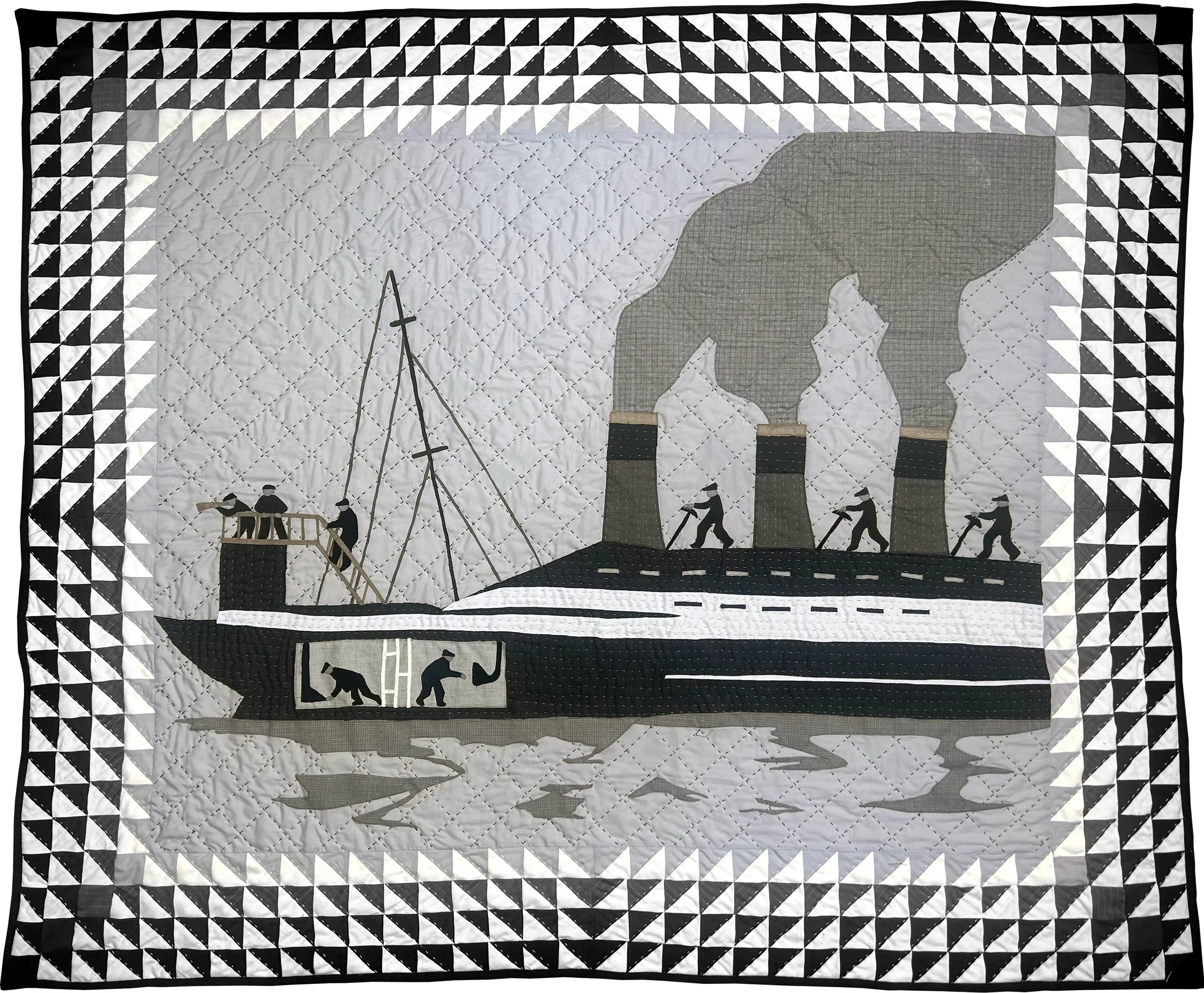
The Big Ship by Emma Goldstein. Image courtesy of Procession Gallery.
I rise above to the third floor where The Big Ship strikes me in the hallway. It’s a quilt by self-taught artist Emma Goldstein, presented by artist and gallerist Graham Cuddy of Philadelphia’s Procession Gallery. Goldstein’s quilt is neither warm nor inviting. You can’t stand back to admire it. You’re forced to look closely at the anonymous workers powering the vessel. Invisible labor on display for those willing to look.
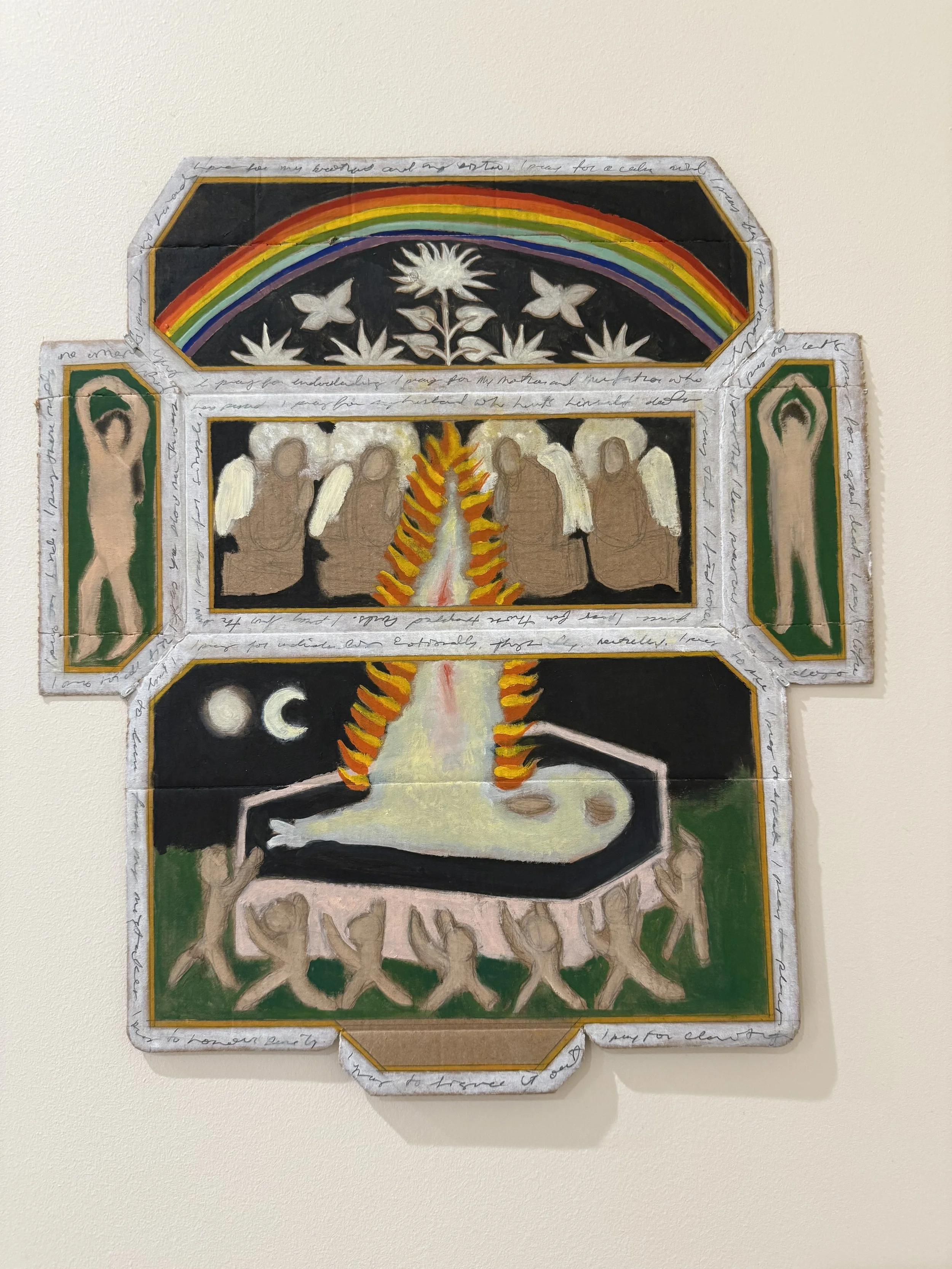
Yvonne Weiss, Nothing New Under The Sun, Oil on Domino’s box, 16 x 15 inches, 2025. Presented by Janey in Suite 305 at Elsewhere Art Fair 2026. Image courtesy of Space On Space Magazine.
Gallerists and visitors had much to say about Elsewhere:
Longtime gallerist Christine Pfister of Pentimenti told me Friday morning that Elsewhere was well worth it and a big moment for Philadelphia. Local artist and writer clancy philbrick commented that he met many great folks and liked the accessible nature of the artists and galleries. Lara Cardoso, founder and director of Canadian-based Janey shared, “As our first hotel art fair, it provided a unique platform to introduce our artists to new audiences and connect with a new community of collectors, curators, and fellow exhibitors.”
“The reception to the work was beyond our expectations, with multiple pieces from all six of our artists placed mostly in Philadelphia collections, which is a testament to the strength of the arts community here,” shared Thomas Martinez Pilnik, co-owner of the Los Angeles Feia gallery. “We spoke with hundreds of visitors, museum curators from PAFA, PMA, the ICA, and the Fabric Workshop and Museum.”
I ended up buying a Matron of the Arts hat from Feia. I wore it on Saturday and several others remarked that they too had purchased Feia hats, including Dr. Matthew Kenyatta, the director of Temple Contemporary.
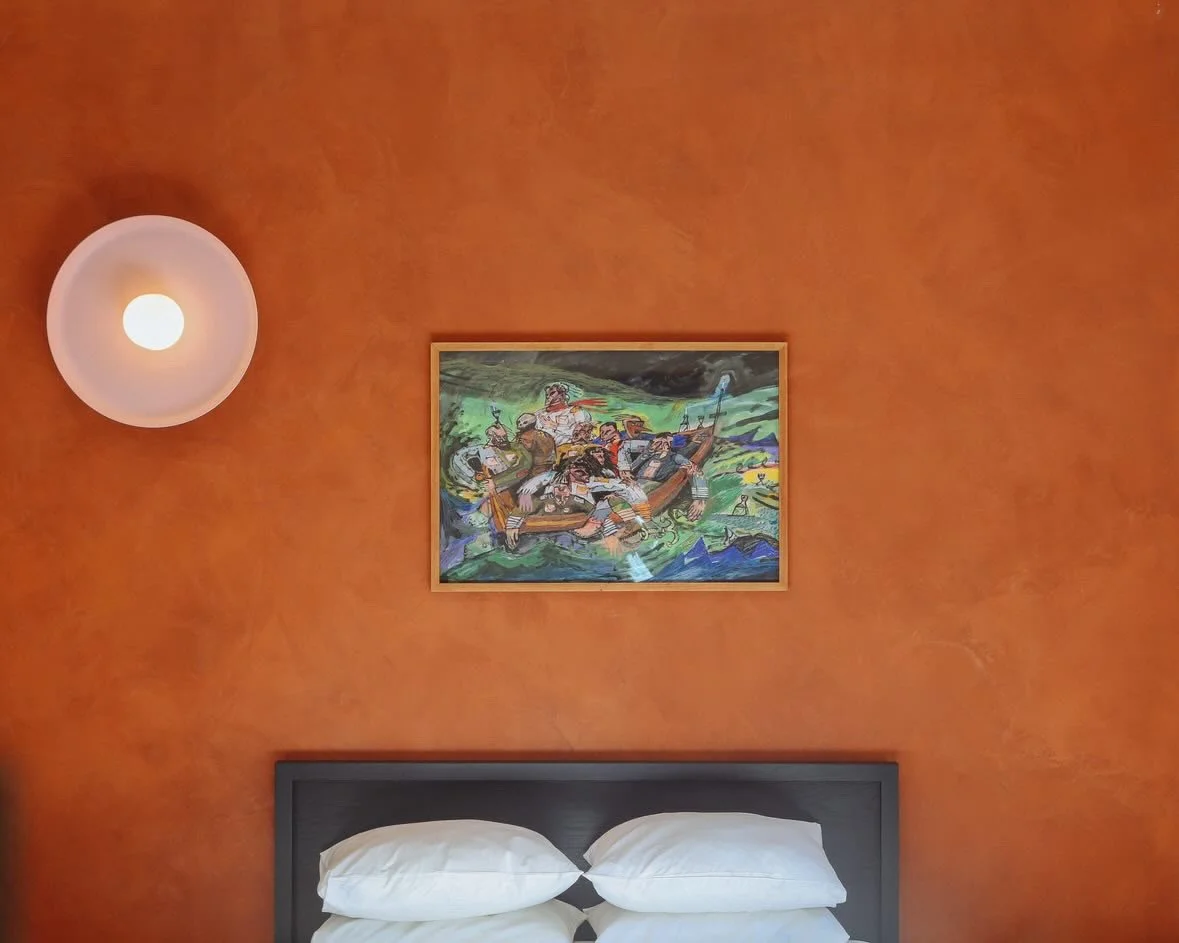
Indiana Hoover. Ship of Fools But Another Title, Oil on paper, 24 x 35 inches, 2026. Images courtesy of Dylan Riley, the director of Stowaway Gallery.
Leah Triplett, curator of contemporary art at PAFA (the oldest art museum in the country), shared, “I heard from many dealers and artists that sales had been strong, and I know everyone always says that, but I also heard from Philadelphia collectors who were buying.”
In its first rendition, Elsewhere had a few kinks to work out, but that’s true for anything new. One anonymous gallerist remarked that because of the casual atmosphere, some visitors thought it was ok to touch the art. And one local artist noted that they “wished to see more Philadelphia-based galleries.” I heard comments about keeping collectors on-site for as many of the fair hours as possible, and scheduling off-site VIP events during after-hours.
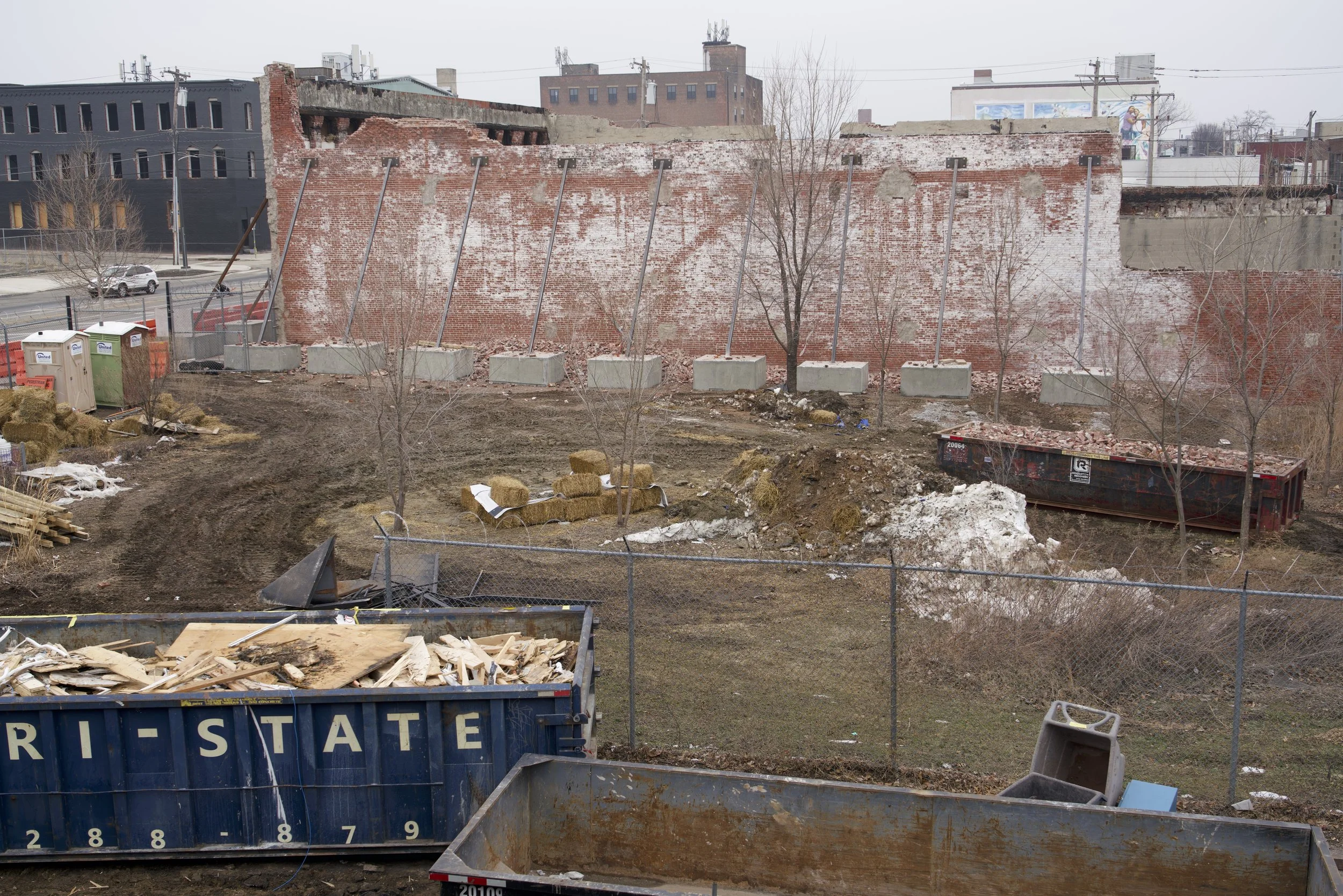
Image courtesy of Jon Kaufman of the construction site for Forman Arts Initiative.
The fair provided numerous tours of Philadelphia’s cultural institutions and studio visits throughout the duration of the program. On Saturday, I was grateful to attend two off-site VIP Elsewhere events, including a group tour of Alex Da Corte’s studio (which I believe may have changed my life) and a hard hat tour of the construction site for the new Forman Arts Initiative (FAI) campus in West Kensington. While visiting these spaces, I learned about an organization called Less Than Half, run by Hall W. Rockefeller focused on equipping women collectors and raising the profile of female artists.
The FAI tour was led by Katie Lee, the collection and exhibitions manager at Forman Arts Initiative. While on the FAI tour, I encountered a Cassi Namoda painting. I’ve admired the Mozambican artist’s work for years online and had yet to see her work in person until being introduced to the Formans’ collection. Lee shared this about the fair, “I participated in Elsewhere both as a host committee member and through my work at FAI, an institutional partner of the fair. Those dual roles allowed me to help expand awareness of the fair, contribute to programming opportunities, and connect it with audiences across Philadelphia, New York, and Washington, DC.”
I also met an impact investor and creative-economy advocate named Margie Bacheler—she’s also a member of Less Than Half. Bacheler shared that, “As a novice art collector, I am formulating my art collecting thesis primarily to purchase art from living artists who live and work within thirty miles of Philly.” She continued, “I am passionate about promoting the arts as an economic development strategy and am excited to see new initiatives such as the Elsewhere Art Fair, Forman Arts Initiative, and the Village of Industry & Art enter into Philly’s arts ecosystem.”
Philadelphians have great pride in their city. City residents serve it with love, even if the city doesn’t always return the favor. Take the many artist-run spaces that invest countless hours and dollars into their cultural programs, often never receiving a full financial return on their investments.
As the global art world navigates current structural and financial quakes—like what we’re seeing with Pace—perhaps there’s something vital to be learned from Philadelphia’s art scene.
Not everyone operates from a heart posture of love and service, but it’s clear to me that many Philadelphia-based galleries have a mindset of hospitality, service, and even a love offering to their matrons and patrons of every gender.
And love is a sustainable path forward.
As the Philadelphia-based artist Todd Stong shared in a recent interview, “If you give of yourself, people will open up to you. And then, sooner or later, if you persist, the gift comes back.”
I hope this gift is something outsiders take with them as they leave the City of Brotherly Love to continue their business operations elsewhere.
Emily Logan is a nomadic art writer and publicist. Since 2020, she’s been building Space On Space. Previously, she worked as a publicist at ArtCenter College of Design in Pasadena, CA. She holds a BFA in Sculpture from Tyler School of Art and an MS in Innovation Management and Entrepreneurship from Fox School of Business, Temple University.
Space On Space is a media movement started in 2020. Originally a cathartic impulse to process the times, SOS has evolved into an investigation into the connections between land, power, and art. The outlet creates content and offers PR services to help artists, designers, and businesses take up more space in the media. At the intersection of art writing and public relations, SOS interrogates the line between mythmaking and the historical archive. The publication has produced three print magazines and a mountain of digital content covering artists from around the world. The magazine hosts parties, art talks, and poetry events. In a media landscape built for speed, SOS slows down—because depth is disruptive, and attention is power.